Discipline & Dogs
I’ve had an obsession with animals since childhood.

My mom recalls fondly that, for several years, my birthday wish was to own an exotic animal—say, a zebra or a giraffe. When I realized that wasn’t a possibility, I set my sights on a dog. And at 5, I got my own puppy, Angel, a miniature schnauzer.
Dog ownership was different when I was a kid in the 90s. As a dog trainer today, I SO often hear “we had dogs growing up, but they weren’t really trained.”
This was certainly the case with Angel and other dogs I interacted with throughout my childhood: They just kind of existed. We fed them and provided vet care, for sure, but that was about it.
They weren’t walked with any consistency. Commands were few and far between. They were wildly unpredictable with strangers and dogs. They were very much just dogs.
Angel died when I was 19. As a college student, my lifestyle (and my bank account) didn’t really permit dog ownership. And as such, I lived the following years dogless.
Inja the Menace

Then, at 23, Inja was dropped off on my doorstep—quite literally.
She was the neighbor’s dog, and he’d reached his last straw with her. She was an
objectively difficult dog. I would be her third home. I was euphoric to have a dog again, and (wrongly) assumed it’d be an easy transition. I thought that, like Angel, I could just feed Inja, provide medical care, and let her just…exist. Cause that’s what dogs do…right?!
Not only did Inja not “just exist,” she was an absolute menace. This was in part due to her breed mix, and in part due to the environment she was raised in.

She’s mainly a mix of three high-demand breeds: roughly 50% Australian Cattle Dog, 25% American Staffordshire Terrier, and 25% Husky. There are some question marks in there, but regardless. She’s a genetic tornado of several breeds that require consistent physical activity, mental stimulation, and structure.
Even worse, Inja’s first few years of life were turbulent (and that’s putting it lightly).
She was pulled out of the desert of New Mexico and was suspected to be a feral dog for the first several months of her life. From there, I didn’t know all of her history, beyond that I was her third home. But based on her behaviors, I presumed it hadn’t been good. She was terrified of people — even me — especially if anyone showed a hint of anger. She took swipes at people and even landed a couple of bites. Yikes.
She ate everything in sight. She destroyed anything in her path.
This breed-behavior mix brought absolute hell into my life. Inja couldn’t be left alone without eating holes in blankets, furniture, plants — you name it. She peed on my bed and shit up the walls. She howled for hours on end, leaving neighbors annoyed and concerned.

Given the chance, Inja would escape. Once, when she was tied up outside, she jumped the fence. The line wasn’t long enough, and she nearly hung herself on the gate. Luckily, she was somehow able to slip her collar.
Yet another time, she scaled my kitchen shelves and ate an entire bottle of doggy pain pills. When I called the vet, she said “okay, don’t freak out, but…”
cue freak out.
That was an expensive mistake. Inja required extensive medical care, and vomited blood for days.
Linda the Malinois
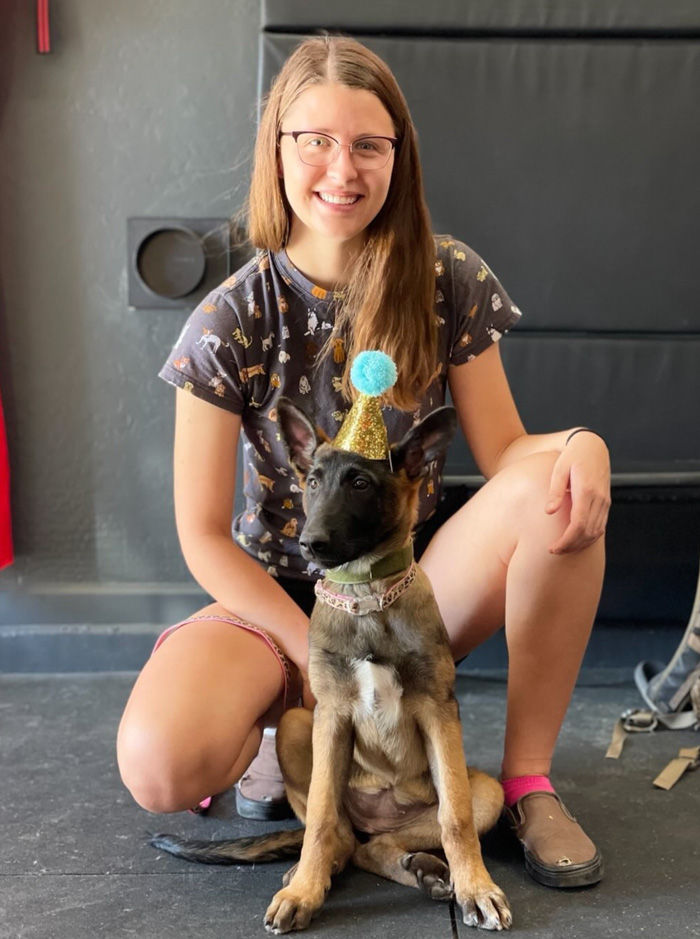
I got Linda, a Belgian Malinois, in 2021 as a 4-month-old puppy. Belgian Malinois are known for their ferocity and difficulty. There are endless anecdotes of them attacking animals, ripping dashboards off vehicles’ interiors, and chewing through aluminum crates. I was fully prepared for her to test approximately ALL of my character
So how much hell did Linda put me through?
None. No really, none. She’s shredded some cardboard (with my permission), and made a couple messes by pulling things off shelves. That’s it. She peed in the house maybe twice before she was six months old, and then never again. She’s never bitten anyone or eaten a toxic dose of Rimadyl, despite the fact that she’s an objectively more difficult dog.
And this isn't a one-off circumstance. Trainer after trainer after trainer claims a similar story.
Which begs the question:
Why was Linda different?
It basically comes down to the old science trope: nature vs. nurture. More accurately, nature and nurture.


In Tails of Triumph, we’ll discuss the nurture element in depth, and how vital it is for dog development. Spoiler alert: a lot of it comes down to your (yes, your) mindset and behavior.
This guide isn’t to help you decide whether you’re ready for a dog or what dog to get. This is for the Inja-owners of the world — those already tits deep in a “difficult dog” and struggling every day.


Comments